
Tamoxifen in breast cancer patients is one of the best examples illustrating how pharmacogenomics can provide drug dosing guidance.
Tamoxifen is an estrogen receptor antagonist in breast tissue, and it is commonly used to treat certain types of breast cancer. Tamoxifen is acted on by several DMEs (CYP2D6, CYP3A4, CYP3A5), and some of the metabolites can have 100 times more antiestrogenic activity than tamoxifen itself.
Tamoxifen may be less effective for individuals who have DME alleles that make them intermediate or poor metabolizers, because they cannot efficiently convert tamoxifen to these active metabolites (Figure 1).
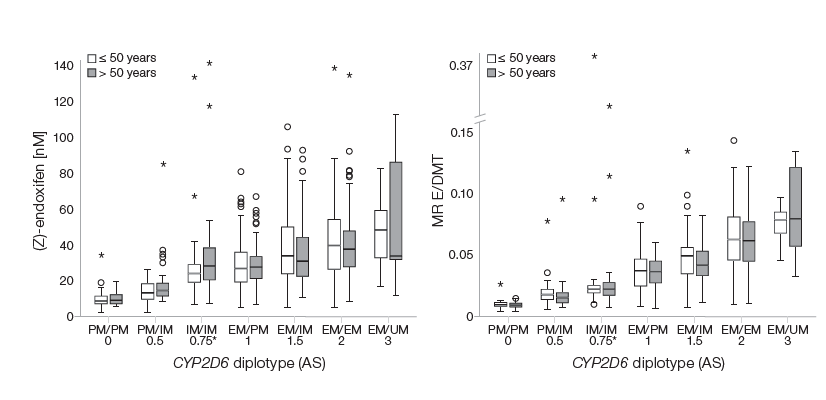
Figure 1. CYP2D6 genotype affects quantities of active tamoxifen metabolites. Tamoxifen is transformed in the liver to (Z)-endoxifen, which has potent antiestrogen effects. The patient plasma concentration of (Z)-endoxifen (left) and the metabolic ratio of (Z)-endoxifen to desmethyl-TAM
(E/DMT, right) depended on CYP2D6 diplotype and age in 897 patients.
PM: poor metabolizer; IM: intermediate metabolizer; EM: extensive (normal) metabolizer; UM: ultrarapid metabolizer. PM and IM patients had lower levels of endoxifen, suggesting higher doses of tamoxifen would be needed to be effective.
From Schroth W et al. (2017) Improved prediction of endoxifen metabolism by CYP2D6 genotype in breast cancer patients treated with tamoxifen. Front Pharmacol 8:582 (doi:10.3389/fphar.2017.00582). This article is distributed under the Creative Commons Attribution 4.0 International License. (CC BY 4.0).
For this reason, several organizations recommend testing and consideration of alternate treatments for these individuals.
Pharmacogenomics can also help patients manage the side effects associated with tamoxifen treatment. Tamoxifen side effects include nausea, anxiety, hot flashes, and pain, so they can cause a patient to seek additional medication and ultimately influence whether the patient stays the course of a tamoxifen treatment regimen. In a study of breast cancer patients in Sweden, He et al. identified a strong correlation between CYP2D6 metabolizer genotype and the use of symptom-relieving
medications by patients receiving tamoxifen.
A larger proportion of ultrarapid metabolizers used symptom-relieving drugs, and a significantly larger proportion of ultrarapid metabolizers discontinued tamoxifen treatment (Figure 2).
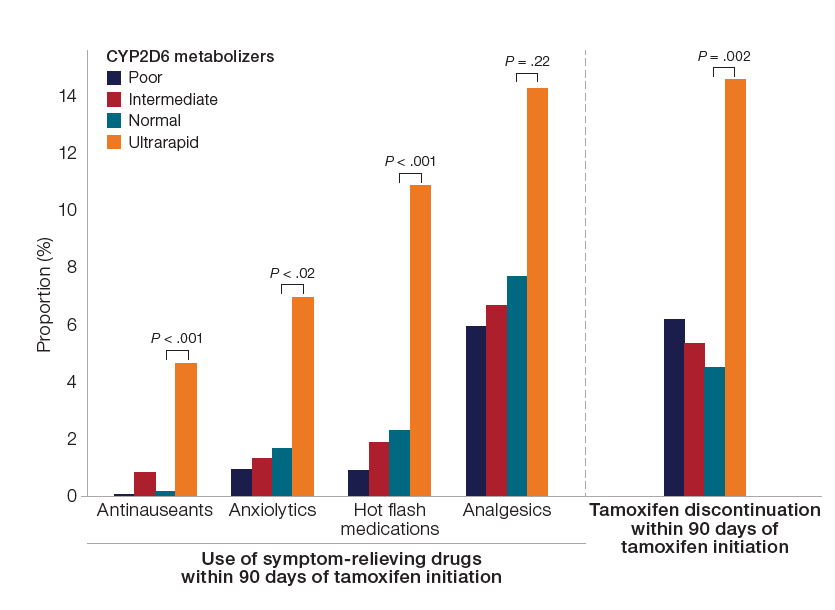
Figure 2. CYP2D6 metabolizer status influences discontinuation of tamoxifen use in breast cancer patients. There was a trend towards increasing use of symptom-relieving drugs coincident with CYP2D6 haplotype. Use was defined as any prescription of a symptom‑relieving drug within 90 days of tamoxifen initiation.
From He W et al. (2020) CYP2D6 genotype predicts tamoxifen discontinuation and prognosis
in patients with breast cancer. J Clin Oncol 38(6):548–557 (doi:10.1200/JCO.19.01535). This article is distributed under the Creative Commons Attribution 4.0 International License (CC BY 4.0).
The side effects of tamoxifen can be managed by adjusting the dose to match the patient’s CYP2D6 genotype, which increases the likelihood that the patient will get the full benefits of complete tamoxifen treatment.
Read also: How Does Genotype Influence Drug Metabolism?