
Like all DNA, the genes that encode drug‑metabolizing enzymes (DMEs) and other proteins that interact with drugs are subject to mutations that can affect protein function. Fortunately, these mutations can be detected easily with common genetic analysis techniques, and individuals can be readily genotyped using blood samples or buccal swabs.
Mutations in DME genes can be broadly categorized in terms of how they affect the quantity of active enzyme. They can either result in loss of function or gain of function, or be neutral. A loss of-function mutation can reduce or eliminate enzymatic activity by interfering with the function of an enzyme or expression of the mRNA that encodes it. Conversely, a gain-of-function mutation can increase enzymatic activity by removing inhibitory control over expression of a gene that encodes an enzyme.
Although rare, a gain-of-function mutation can also make an enzyme more efficient. Neutral mutations are sequence changes that have no effect on protein function or abundance.
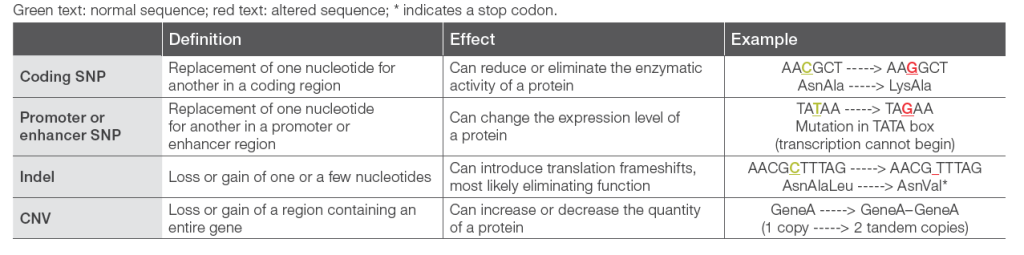
Mutations can also be grouped into the four categories listed in below Table. Single nucleotide polymorphisms (SNPs), also known as single nucleotide variants (SNVs), are variations at single nucleotides in DNA sequences. A SNP that falls in the coding region of a gene can change the amino acid sequence, and consequently the function, of the protein the gene encodes.
If a SNP falls in a promoter or enhancer region, it can alter when, where, and how much protein is synthesized.
Insertions and deletions (indels) are mutations involving one or a few nucleotides. Indels have more impact when they occur in coding sequences because they can cause reading frame shifts, which change the amino acid sequences downstream and may introduce premature stop codons.
A copy number variant (CNV) is the result of deletion or duplication of an entire gene or region within a gene. These mutations can alter the amount of protein produced by cells and usually occur in the germline, so they are distributed uniformly in all tissues.
The amount of functional enzyme in a cell is also affected by the allelic makeup of the individual. Every cell contains two copies of each gene on autosomal chromosomes, and each copy (allele) can contain any of the sequence variations described in below Table. If both copies of a DME gene encode a normally functioning enzyme, drug metabolism by that enzyme will be normal.
However, if one allele encodes the normally functioning enzyme and the other contains an inactivating mutation, the activity of the enzyme will be lower by half. Conversely, having one normal allele and one allele with a CNV duplication can increase the activity of the enzyme by 50%.
There may be no active enzyme at all if both alleles contain inactivating mutations. Different combinations of alleles can result in a spectrum of enzymatic activity, and it is often convenient to describe individuals based on the amounts of active enzyme they have.
For example, particular CYP2D6 allele combinations can make an individual an ultrarapid metabolizer (UM) with elevated enzymatic activity, an extensive (normal) metabolizer (EM) with average enzymatic activity, an intermediate metabolizer (IM) with low enzymatic activity, or a poor metabolizer (PM) with
no enzymatic activity.
Such phenotypic characteristics are used to describe a response to a drug, and knowing an individual’s metabolizer phenotype is critical to ensuring the right drug is administered at an appropriate dose.
Pharmacogenomics researchers use star allele nomenclature to refer to alleles. In this system, alleles are not identified by the positions of variants in cDNA, genes, or proteins (e.g., g.27289C > A or p.T398N); instead, an allele is denoted by the name of the gene followed by an asterisk and a number.
For example, CYP3A52 identifies the g.27289C > A variant in the CYP3A5 gene, which encodes a CYP enzyme with a T398N mutation. Star allele nomenclature can simplify reference to important alleles and accommodate haplotypes with multiple mutations that are tightly linked. This nomenclature also makes it easy to describe heterozygotes (e.g., CYP3A52/*5).
Table: DNA sequence variants that are commonly found in DME alleles with different activities
Read also: Pharmacogenomics: The Foundation of Personalized Therapy