
Although modern medical science has developed an extensive pharmacopeia to target a wide variety of pathologies, we know that not everyone will respond the same way to a given drug (See below figure).
Some individuals will experience the desired outcome, some individuals will have a limited response or none at all, and others may suffer adverse drug events (ADEs). ADEs are unintended and harmful side effects that range from relatively mild discomfort (e.g., nausea) to organ damage and other life‑threatening outcomes.
ADEs can result from an individual’s genetic makeup, specifically the genes that encode drug‑metabolizing enzymes (DMEs).
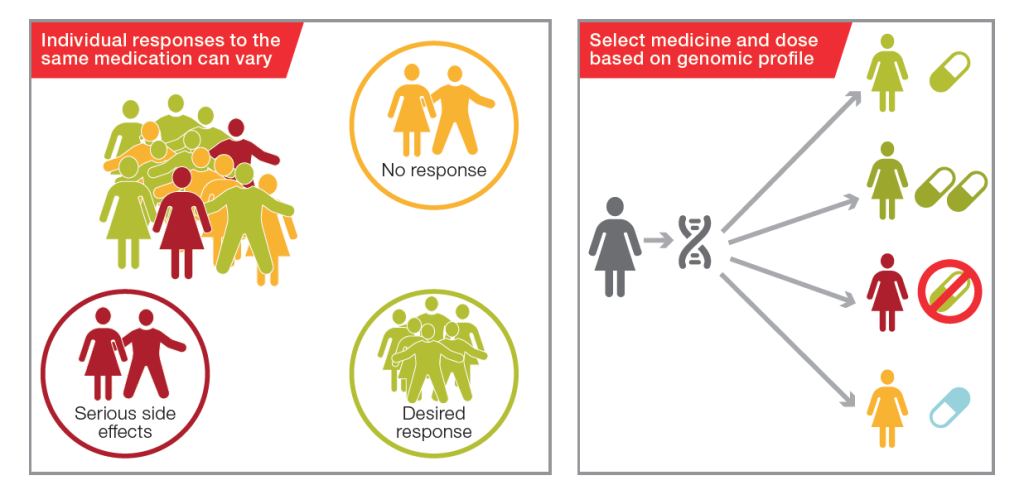
Figure: Pharmacogenomics attempts to match the drug-related metabolic genotypes of individuals with appropriate drugs and dosages.
- Left: Some individuals in a population will have the desired response to a drug, but others may not respond to the drug at all or experience serious side effects.
- Right: Some individuals will respond to a drug at the standard dose (light green), while others may require twice as much for the drug to be effective (dark green). Some individuals might have serious reactions and should not take the drug (red), and some individuals may not respond and require a completely different drug (yellow).
Pharmacogenomics (PGx) combines knowledge about drug metabolism pathways and genomics to understand how individual genetic profiles influence responses to medications.
The goal of pharmacogenomic analysis is to match a drug to a person’s DME-related genetic makeup. Simply stated, PGx holds the promise of ensuring the right drug is administered to the right patient at the right dose.
This includes determining whether a drug might be harmful and best avoided or simply ineffective and if a different strategy might be appropriate. PGx also attempts to inform the proposed treatment regimen to mitigate the risk of ADEs and increase the likelihood of seeing the treatment through to completion.
This approach has the potential to produce better outcomes for patients, because healthcare providers can administer the most appropriate and effective treatments based on the unique genetic characteristics of their patients.
Read also: Common Definitions in Pharmacogenomics